For employers

Mental health you can calculate.

We deliver measurable programmes with a pilot group first, measurement along the way and a decision on roll-out afterwards. With AstraZeneca we have had a long-term partnership since 2021, and Trollhättans Stad started the same way before rolling out more widely.

Read about the AstraZeneca collaboration
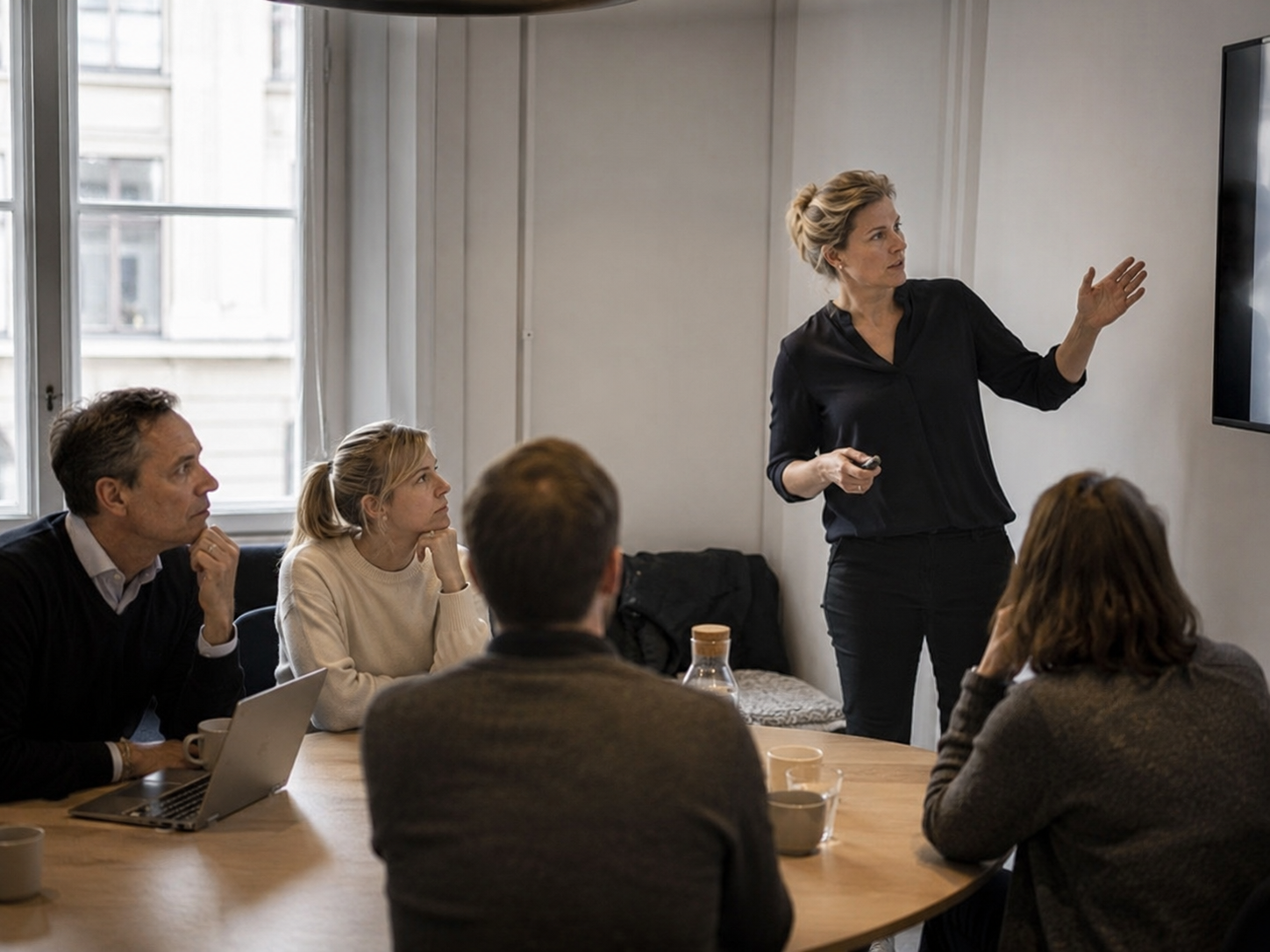
A person presenting results to a small group around a table.
Worked example

Work out what poor mental health costs you

This is a worked example, not a promise. But every assumption can be swapped for your own figures, so here is the basis.

500 office employees, here is the cost

  • Average cost per day of sickness absenceSEK 2,800
  • Average sickness absence per employee per year8.6 days
  • 500 employees × 8.6 days × SEK 2,800SEK 12.0m
  • Assumed share linked to poor mental health≈ 30%

SEK 3.6m

Estimated annual cost of poor mental health in the example.

A worked example with assumed values. The cost of a day of sickness absence and the share attributable to poor mental health vary between employers. We run the numbers on your actual figures in the intro call. Source: Försäkringskassan and Skandia, 2025.

How we calculate

  • Cost per sick day, SEK 2,800. A common standard figure corresponding to roughly ten per cent of an average monthly salary, once you include lower productivity and administration.
  • Sickness absence, 8.6 days per employee per year. Close to the average for Swedish office employees according to Statistics Sweden.
  • Share linked to poor mental health, 30 per cent. We deliberately keep this low. Försäkringskassan shows that psychiatric diagnoses account for close to half of all long-term sick leave.

A five per cent reduction equals SEK 180,000 a year in the example. At that point the investment has paid for itself.

And this is not calculated in a vacuum. Loipart reduced stress risk from 14 to 5 per cent in six months, measured by an external party, and Trollhättans Stad improved stress management by 47 per cent. See the results

Worked example

Work out the focus you could free up

The other side of the same coin. Beyond reduced ill health, better focus frees up time that already exists, with no overtime. This too is a worked example, so swap the assumptions for your own.

This much focus time can be reclaimed

  • Waking time we spend thinking about something other than what we are doing≈ 47%
  • Working time per employee per month160 hrs
  • Focus time lost per employee per month≈ 75 hrs
  • Assumed improvement with regular training10%

7.5 hrs

reclaimed focus time per employee per month

A worked example with assumed values. The 47 per cent refers to waking time in the study and is applied here in simplified form to working time. We run the numbers on your actual figures in the intro call. Source: Killingsworth and Gilbert, Science, 2010.

How we calculate

  • Share of waking time we spend thinking about something other than what we are doing, around 47 per cent. From the Harvard study A Wandering Mind Is an Unhappy Mind, Killingsworth and Gilbert 2010, which measured 2,250 people in real time.
  • Working time, 160 hours a month. For around 47 per cent of that time the mind is often somewhere else, which comes to roughly 75 hours.
  • Improvement, 10 per cent. We deliberately keep this low. Even at that level, about 7.5 hours of focused time per employee per month is reclaimed.

At an internal cost of SEK 400 an hour, that equals roughly SEK 33,000 per employee per year. For a team of 50 people it comes to well over SEK 1.6 million, without anyone having to work more.

The buying group

We speak to the whole buying group

CEO

Business value and a clear link to results, productivity and the ability to retain key people.

HR Director

Fewer sick days, a stronger employer profile and a set-up that is easy to own internally.

Health and safety manager

Practical support for systematic work environment management and the requirements of OSA under AFS 2023:2.

Wellbeing ambassador

Something engaging to drive internally, with materials and sessions colleagues actually want to attend.

Line manager

Tools for your own team, from psychological safety to sustainable performance day to day.

OSA is no longer a recommendation

Since 1 January 2025, AFS 2023:2 on the organisational and social work environment (OSA) applies. It places a clear responsibility on the employer to prevent unhealthy workloads and build a work environment where people feel well and perform. Mental training is one of the more concrete ways to put that responsibility into practice.

Why Mindworkout

Five reasons to choose preventive mental training

  1. 01

    Preventive, not firefighting

    We train mental fitness before it turns into sick leave, rather than dealing with ill health after the fact.

  2. 02

    Can be rolled out broadly

    Short, instructor-led sessions that are cost-effective enough to give the whole organisation, not just a select few.

  3. 03

    Measurable effect

    We measure mental fitness and wellbeing before, after and three months later, so you see the result linked to the effort.

  4. 04

    Linked to OSA

    The work helps you turn your work environment responsibility under AFS 2023:2 into concrete, documented practice.

  5. 05

    Ten years of experience

    Since 2015 we have trained Swedish employers from industry and finance to the public sector.

A team taking part in a session during a pilot programme.
What you get in the pilot programme
  • A three to four month programme for one or two teams
  • Measurement of mental fitness before, after and at follow-up
  • Instructor-led live sessions of no more than 30 minutes
  • Data and figures to support a decision on wider roll-out
Book an intro call
How we start

A pilot, a measurement, a decision based on real figures

Step 1

Test group

We start with one or two teams where the need is clear and the manager is on board. A three to four month programme with recurring sessions.

Step 2

Measurement

We measure mental fitness and wellbeing before, after and three months later. You see the effect linked to the effort.

Step 3

Roll-out

If the figures show progress, we scale up to more teams. If they do not, you have learned that cheaply, without a broad investment.

Frequently asked questions

What employers most often ask

Curious about what you could free up?

Twenty minutes is enough to see where you stand and what a first step could deliver.

Book an intro call